
EnergyLane's Dual-Use Solar Tech Protects PEI's $1B Potato Industry & Secures Net-Zero
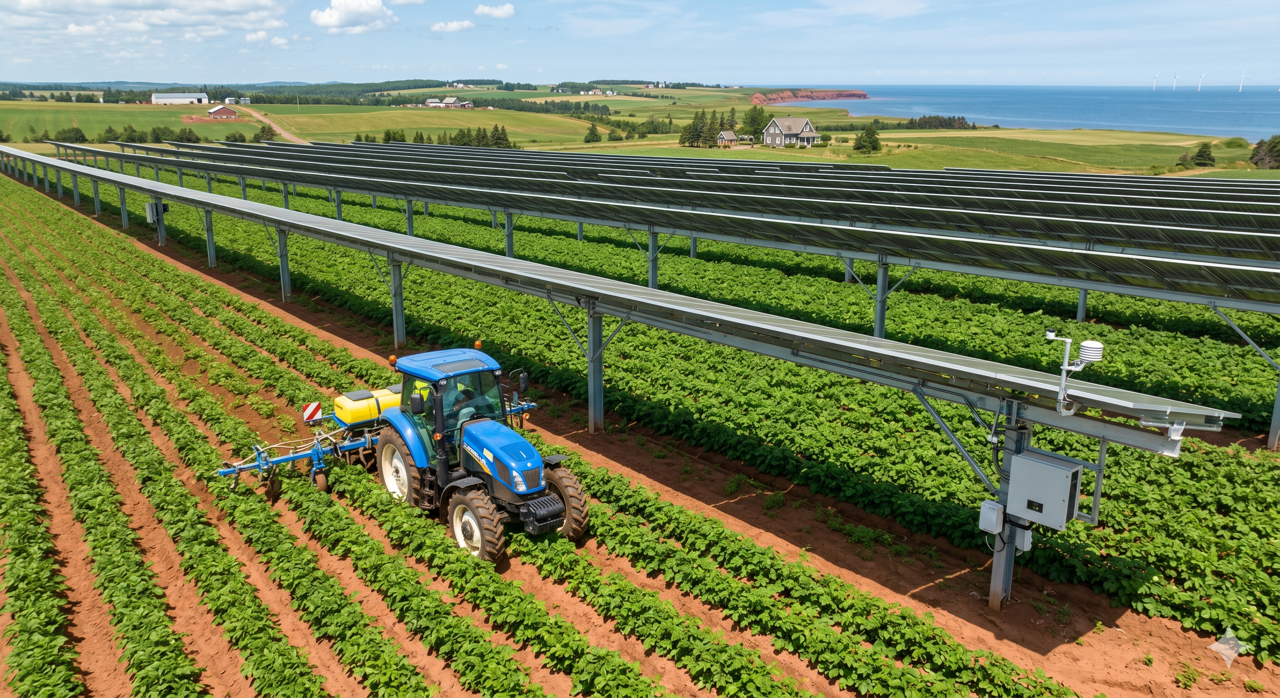
EnergyLane's agrivoltaic micro-shading arrays are elevated 4.5 meters, allowing commercial farming equipment to operate unimpeded while protecting potato crops from extreme summer heat.
UPEI cleantech founder Austin Gboru introduces an elevated agrivoltaic framework to stop solar developers from cannibalizing prime PEI potato farmland.
To meet its future energy needs and reduce an 85% reliance on mainland power cables, PEI requires approximately 300 Megawatts (MW) of new localized solar capacity. Using traditional, ground-mounted solar panels, this mandate would require stripping over 2,100 acres of flat, sun-drenched land out of the ecosystem. In a province governed by a strict 3-year crop rotation to protect soil health, the loss of 2,100 acres of prime arable land would structurally destabilize the island’s $1 Billion potato industry.
Through his company, EnergyLane, Gboru is proposing the immediate transition to agrivoltaic technology. This dual-use solar infrastructure elevates solar arrays 4.5 meters (14.7 feet) above active crops, allowing commercial farming equipment to operate entirely unimpeded beneath them.
"We do not have to choose between clean energy and food security," said Austin Gboru, Founder of EnergyLane. "Sinking traditional solar panels into active arable land is a failure of engineering. Our infrastructure elevates the grid, actively protects the crops from climate-induced heat stress, and keeps the family farm economically sovereign. We are empowering the PEI farmer to become the island’s primary energy developer."
Unlike traditional opaque solar farms that suffocate the soil biome, EnergyLane’s micro-shading arrays are geometrically calibrated specifically for the Solanum tuberosum (Russet Burbank potato). The technology delivers three immediate provincial benefits:
Climate-Adaptive Agriculture: By blocking harsh midday zenith radiation during July and August droughts, the solar canopy caps soil temperatures, prevents the potato from entering heat-induced dormancy, and reduces water evaporation by up to 30%, preserving the island's vital groundwater aquifers.
Hurricane-Grade Grid Resilience: Anchored by deep-driven helical piles designed to bypass the PEI frost line, the arrays utilize AI-driven trackers that automatically rotate panels into a vertical "stow" position during extreme weather (such as Hurricane Fiona), physically shedding snow loads and preventing wind shear collapse.
Family Farm Protection: By leasing the airspace rather than purchasing the land, EnergyLane bypasses the restrictive PEI Lands Protection Act and provides generational farmers with a guaranteed, weather-independent secondary income stream via Power Purchase Agreements (PPA).
EnergyLane is currently aligning with the UPEI Cleantech Academy, the Atlantic Canada Opportunities Agency (ACOA), and local agricultural stakeholders to initiate its Phase 1 commercial pilot deployment in the province.
About EnergyLane
EnergyLane is an infrastructure development firm specializing in dual-use agrivoltaics and decentralized grid modernization. By bridging the gap between agronomy and utility-scale renewable energy, EnergyLane designs proprietary structural architectures that stabilize rural power grids while actively enhancing commercial crop yields.
Austin Gboru
EnergyLane Canada Inc.
aagboru@upei.ca
Visit us on social media:
LinkedIn
X
Legal Disclaimer:
EIN Presswire provides this news content "as is" without warranty of any kind. We do not accept any responsibility or liability for the accuracy, content, images, videos, licenses, completeness, legality, or reliability of the information contained in this article. If you have any complaints or copyright issues related to this article, kindly contact the author above.
