

90% or more of Apple, Microsoft, Lilly and Costco Market Value is IP-related, CIPU Illustration Shows
Many of today's most valuable companies are fueled primarily by trademarks, patents and reputation, not "tangibles," like real estate and equipment
Today’s corporations are learning to embrace value from an industrial economy built on tangible assets to a knowledge economy built on intellectual property”
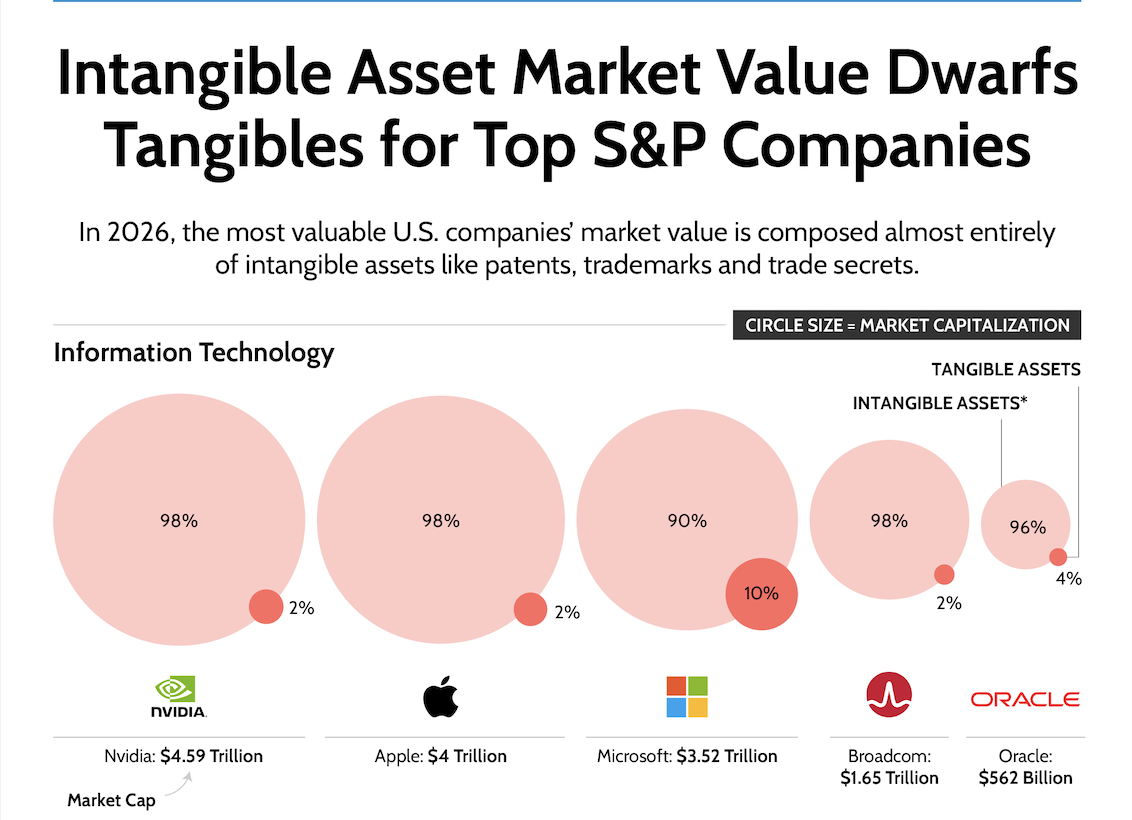
NEW YORK, NY, UNITED STATES, March 31, 2026 /EINPresswire.com/ -- Nvidia, Apple and Broadcom are the leaders in the Information Technology industry when it comes to intangible assets, those you cannot necessarily see or touch, with 98% of their value attributed to Intangible Asset Market Value, mostly IP rights. — Brian Hinman, fmr Chief IP Officer, Philips and Licensing Director, IBM
For Microsoft, intangibles comprise 90% of its value. The difference is likely attributable perceived company value and financial reporting weaknesses that favor hard assets.
This data is part of a research project, "Comparing Intangible Asset Market Value of Leading S&P 500 Index Companies and Industries," conducted by the Center for Intellectual Property Understanding (CIPU), a nonprofit that tracks trends in IP awareness, education and rights.
Tangible company assets are items like real estate, product inventory and equipment. Intangibles include more difficult to value but nonetheless foundational assets, like patents, trademarked brands, copyrights, trade secrets, institutional knowledge, customer lists and reputation.
For the past 20 years Ocean Tomo, an intellectual property merchant bank and consulting firm, now owned by J.S. Held, has been tracking overall Intellectual Asset Market Value (IAMV) of the S&P 500 Index of public companies. Ocean Tomo reports that in 1975 only 13% of market value attributable to intangible assets; in 1995 the figure had risen to 68%; in 2005 it was 2025 80% and in 2025 it had grown to 92%. The CIPU research endeavors to drill down on those figures by identifying the asset allocation based on specific leading S&P Index companies and industries to compare the role that intangible assets play in market value, figures that often have more to do with perceived value than actual balance sheet itemization.
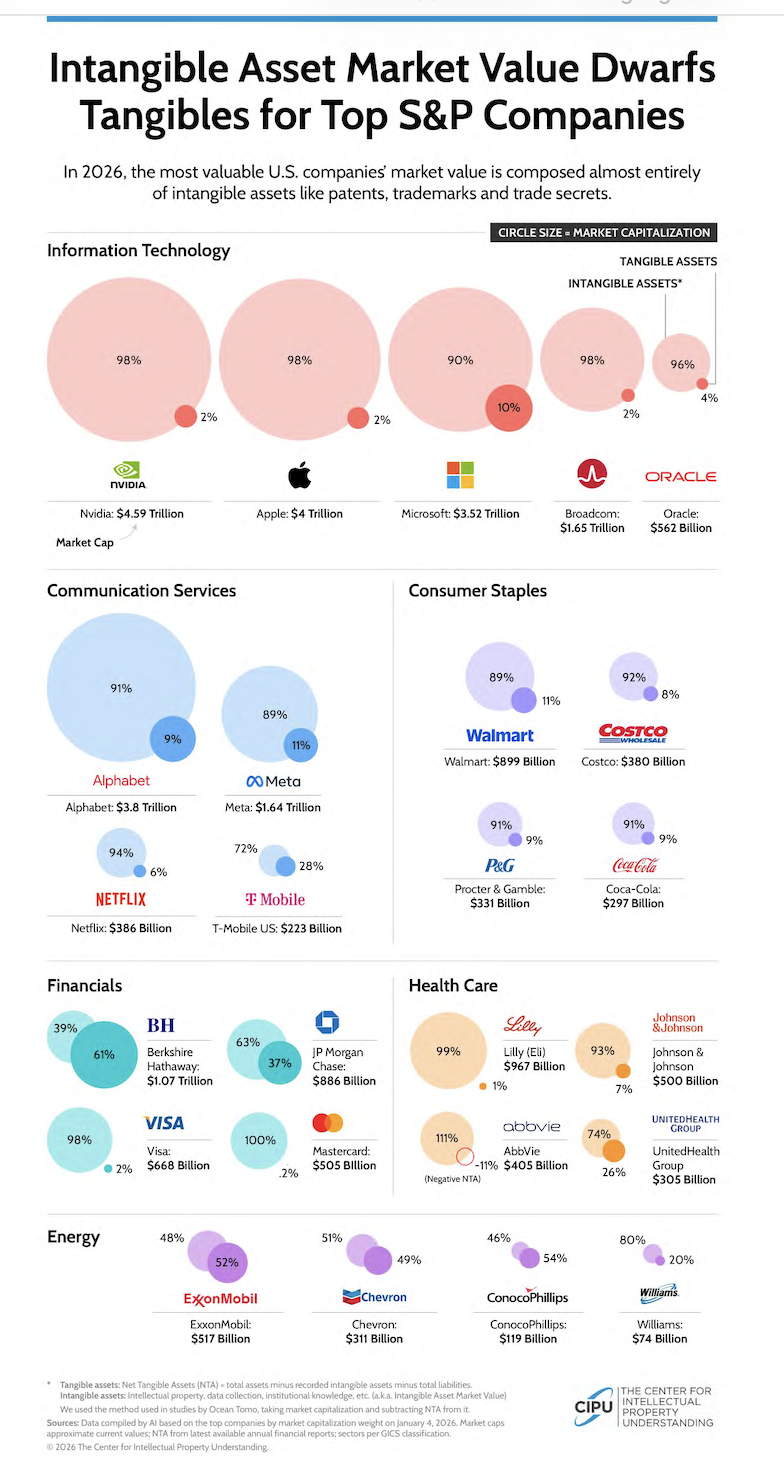
Information technology is a leader when it comes to IAMV. But even within IT there are differences (see attached illustration). For example, Microsoft’s IAMV is 90% vs. 98% for Nvidia, Apple and Broadcom. Identifying which components within intangible assets are the most valuable, patents vs. brand vs. trade secrets vs. customer lists, would be a worthy but challenging task that can help discern what underlies company value today. (The current current project is the first subject in future CIPU research on intangible assets.) For Nvidia, for example, patents likely mean a great deal and brand considerably less; for Apple, patents are certainly important but it is brand - or, more accurately, brands - that are the more significant driver of market value.
"The growth of intangible assets as a component of company market value is up 35% since 1995, and almost five-fold since 1975," said Bruce Berman, Chairman of CIPU. "Tangible assets today account for 2% or less of the market cap of IT and other companies. Successful businesses no longer live in a world dominated by hard assets, like real estate; IP rights and reputation fuel share price."
It is important to remember that these figures are thumbnails that illustrate the increased relative importance of IAMV. They are not precise calculations for M&A , accounting or transaction purposes, but an affirmation of the increasingly small part tangible assets play today in company market value. Market capitalization is effectively perceived company value as expressed in equity share price. Intangibles like IP rights and human capital are playing a greater role than many realize. This means that it is more essential today to get one's arms around contributions to a business value made by intangible assets. Better understanding their value and the role they play in market cap is highly important and will continue to be. AI with the right LLM or SLM may be just the tool needed to make that happen.
“Today’s corporations are learning to embrace value from an industrial economy built on tangible assets to a knowledge economy built on intellectual property, Brian Hinman, former Chief IP Officer at Philips and a licensing executive at IBM, InterDigital and Verizon, told the Intangible Investor. “For most businesses, patents, brands, data and know-how are the primary drivers of corporate value and must be understood in the context of their industry.”
The method used in the CIPU research is the same one used by Ocean Tomo in its summaries since they were first introduced in 2006: company market capitalization (market cap) minus net tangible assets (NTA) equals Intangible Asset Market Value (IAMV).
For comparison purposes, the other industries CIPU includes are Communication Services, Consumer Staples, Financials, Healthcare and Energy (see illustration). Communications Services leaders include Alphabet, Meta and Netflix, while in Consumer Staples, Walmart, Costco, P&G and Coca-Cola all have around 90% intangible asset value, surprisingly close to Communications Services.
When we get to Financials, Health Care and Energy, the balance begins to change, no doubt because of emphasis on different types of intangible assets in different industries. At Visa and MasterCard 98% and 100% of their market value is attributed to intangible assets. For Health Care its 99% for pharmaceutical company Lilly, which relies heavily on patents, vs. 74% for United Health Care Group, primarily a service provider.
For the Energy sector, ExonMobil, ConocoPhillips and Chevron were all around 50-50 between IAMV and tangible value. Despite holding many formidable IP rights, the continued high price of their oil inventories, a tangible asset like no other, likely plays a part.
For the full story, visit the "Intangible Investor" on IPWatchdog.
Forthcoming from CIPU is a deeper dive that will help identify large and small company intangible assets to determine how much of a role components like trade secrets, brand and reputation play in market capitalization. It is probably more than many investors and executives realize.
About CIPU
The Center for Intellectual Property Understanding is an independent nonprofit established in 2016 that raises awareness about the impact of IP rights on creators, businesses, and society. CIPU provides outreach to a range of audiences to improve familiarity and promote sharing. It holds events, such as the annual IP Awareness Summit®, curates IPBasics.org and IdeasMatter.com, both information portals, and produces ‘Understanding IP Matters,’ a top-rated IP podcast series. UIPM provides leading creators, entrepreneurs and industry experts a platform to share their IP story. To learn more, visit understandingip.org.
Bruce Berman
Center for IP Understanding
+1 917-225-6184
email us here
Visit us on social media:
LinkedIn
Instagram
Facebook
YouTube
X
Legal Disclaimer:
EIN Presswire provides this news content "as is" without warranty of any kind. We do not accept any responsibility or liability for the accuracy, content, images, videos, licenses, completeness, legality, or reliability of the information contained in this article. If you have any complaints or copyright issues related to this article, kindly contact the author above.
